
AJIPHASE™ for Peptides
AJIPHASE™ provides a scalable manufacturing platform for peptides, particularly high-volume therapeutics such as GLP-1 analogs and complex structures such as multi-cyclic peptides. The liquid-phase process enables efficient large-scale production with reduced amino acid, reagent, and solvent consumption while utilizing standard chemical manufacturing equipment.
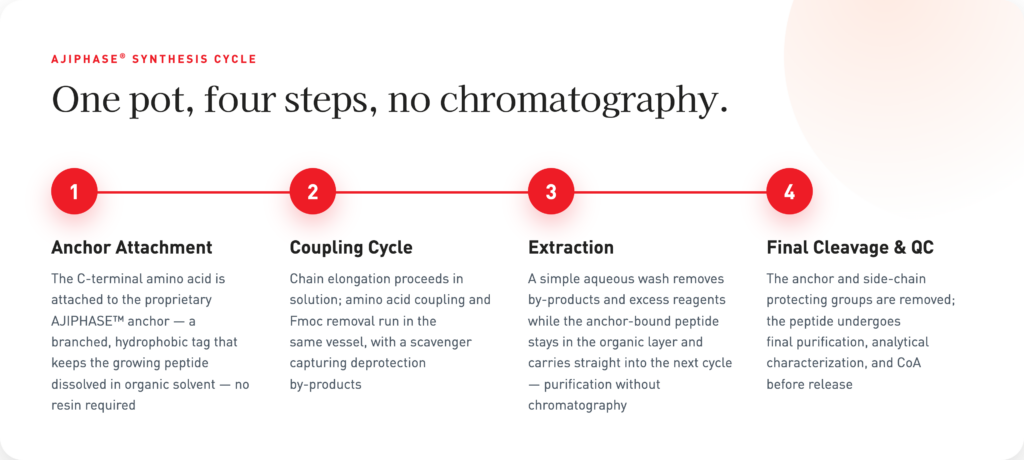
The AJIPHASE™ Process for Peptides: Step by Step
For peptides, AJIPHASE™ attaches the growing chain to a proprietary hydrophobic anchor, so every coupling and deprotection step runs in solution. Between cycles, by-products and excess reagents are removed by simple extraction — no chromatography and no isolation of intermediates — until final cleavage and purification.
Why AJIPHASE™ for Peptides
AJIPHASE™ is our preferred route for most peptide programs — and we recommend the right synthesis strategy for each sequence. For very short sequences with unusual chemistry, our team will advise on the optimal approach.
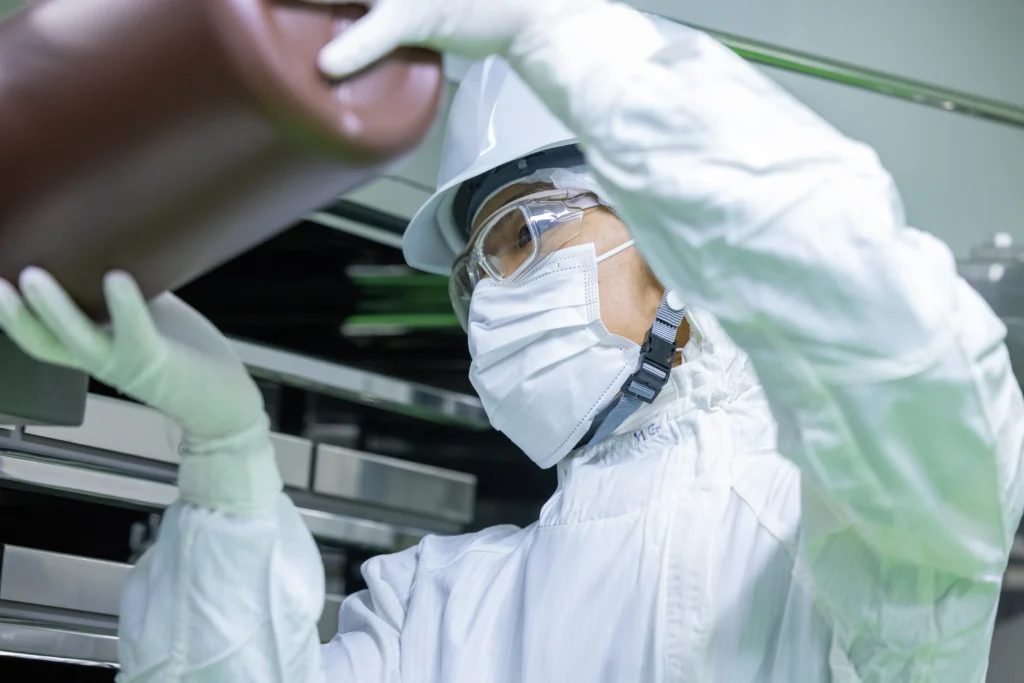
Scale When You Need It
Programs that start on AJIPHASE™ stay on AJIPHASE™ through clinical supply. Same process, same team, same documentation — no CDMO handoff and no new CMC filing when you scale.
Lower Solvent and Reagent Consumption vs. SPPS
Even at small scale, AJIPHASE™ requires fewer equivalents of activating reagents and less solvent per cycle than solid-phase synthesis. Quantifiable improvement in PMI — confirmed via our EcoPass sustainability tool.
Broad Modification Support in a Single Platform
Cyclic peptides, disulfide-bridged structures, PEGylated variants, lipidated sequences, non-natural amino acids — the modifications that define modern peptide therapeutics are all supported within the same AJIPHASE™ workflow.
Standard Equipment — Straightforward Technology Transfer
AJIPHASE™ runs in standard chemical reactors — no proprietary synthesizer hardware required. For programs moving to in-house manufacturing or a nominated CDMO, the technology transfers cleanly.

A More Sustainable Path to Scale
AJIPHASE™ supports more sustainable peptide manufacturing by reducing solvent consumption by up to 90% compared with traditional SPPS. By lowering solvent, reagent, and raw material use, the platform helps reduce environmental impact while improving manufacturing efficiency. Ajinomoto Group also received an EcoVadis Gold sustainability rating for the third consecutive year, ranking in the top 5% of companies worldwide in the 2025 assessment.

Reduced Solvent Use
Simple extraction replaces column chromatography at each coupling cycle — significantly less solvent consumed per gram of product vs. solid-phase at equivalent scale.

No Resin Waste
Solid-phase synthesis generates spent resin waste at every batch. AJIPHASE™ eliminates resin entirely — the anchor is recovered, not discarded.
EcoVadis Gold Certified
Aji Bio-Pharma holds EcoVadis Gold certification for sustainability performance.

Let’s discuss AJIPHASE™ for your program
Same process. Same team. Every scale.
Frequently Asked Questions
What is the difference between AJIPHASE™ and solid-phase peptide synthesis (SPPS) for peptdies?
Both AJIPHASE™ and solid-phase peptide synthesis (SPPS) use the same fundamental peptide coupling chemistry — the impurity profiles are comparable and analytical comparability is maintained. The key difference is scale: SPPS faces practical limitations above approximately 10 g due to resin-column geometry, while AJIPHASE™ performs synthesis in solution using standard chemical reactors, scaling to production exceeding 100 kg per batch under the same process conditions used at lab scale. For short-chain programs, this means a program starting on AJIPHASE™ can progress to clinical supply without a platform switch, a new CDMO relationship, or updated CMC filings. AJIPHASE™ also uses fewer solvents and reagent equivalents per cycle compared to SPPS, reducing waste and manufacturing cost at equivalent volumes.
What is the maximum scale for AJIPHASE™ peptide manufacturing?
AJIPHASE™ has demonstrated cGMP peptide manufacturing at scales exceeding 100 kg per batch. Achievable scale depends on peptide characteristics, manufacturing strategy, and equipment. Conventional liquid-phase synthesis and hybrid manufacturing approaches are also available.